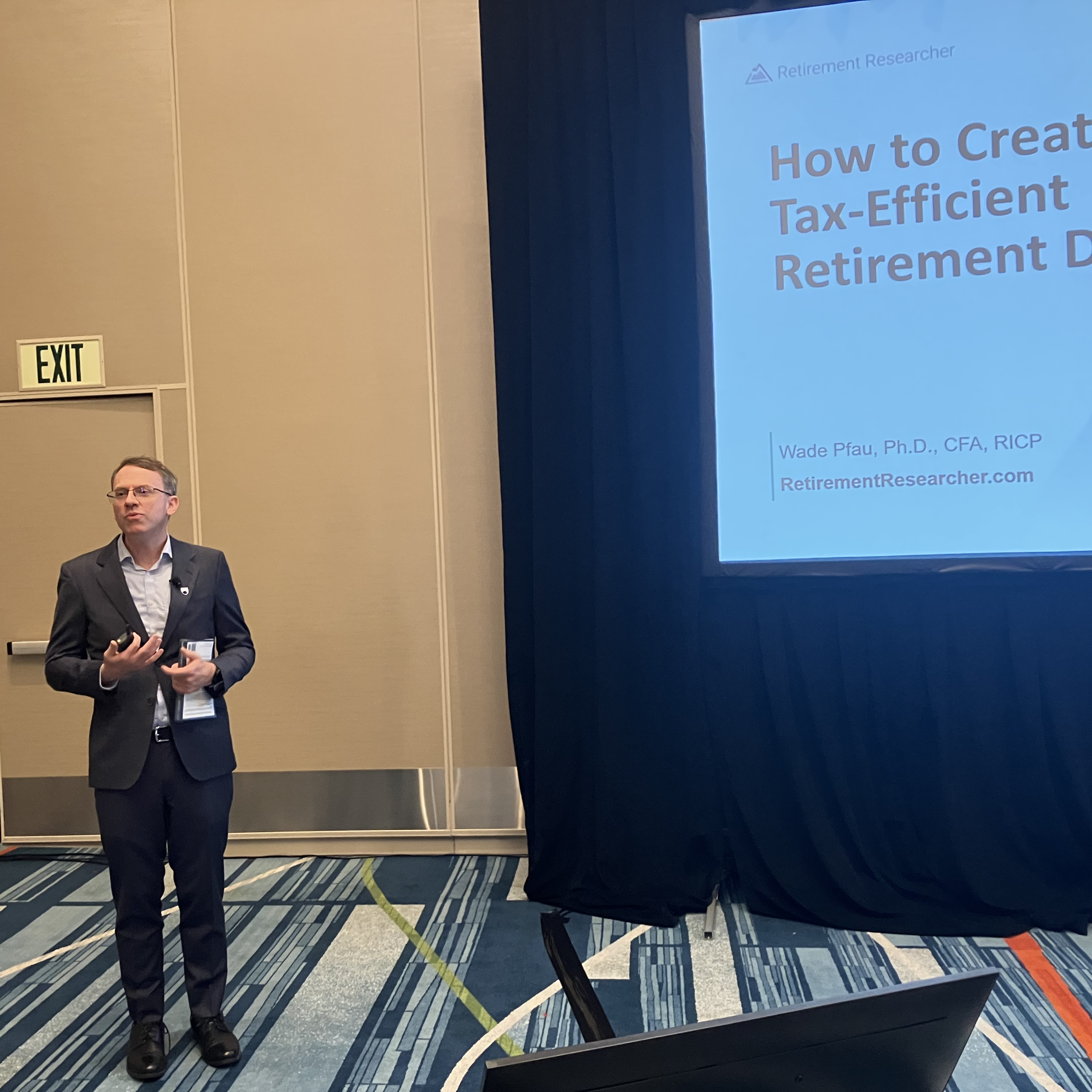
 Wade Pfau
Clients have plenty of reasons to frontload taxes, said Wade Pfau, a professor of practice at the American College of Financial Services and founder of Retirement Income Style Awareness.
Public policy unknowns and risks of tax increases need to be acknowledged, of course. Also, the death of a spouse comes with distinct tax implications, as taxes can increase as a client becomes a single filer again.
Techniques to help clients achieve their tax goals were the focus of Pfau's session at the college's Horizons 2026 retirement planning conference.
The tax code is filled with non-linearities and traps, said Pfau. In a progressive tax system, income tax rates rise with earnings. The marginal tax rate structure means higher rates can be paid on the last dollar of income, he said.
"There are many different types of tax treatment in the tax code that need to be coordinated," he said.
Preparing to reduce consequences like the so-called "retirement tax cliff," in which required minimum distributions can unexpectedly push clients into a higher tax bracket, is essential.
Pfau's approach, called effective marginal rate management, calls for paying taxes at the lowest possible rates and drawing retirement income from other sources to avoid higher tax rates. Reducing future RMDs can help clients avoid being forced into higher tax brackets.
"This short-term sacrifice can create immediate benefits," he said.
There are several techniques to generate voluntary taxable income, said Pfau. Clients can cover their spending needs from taxable accounts and increase taxable income by doing Roth conversions with assets from a tax-deferred account. They can also generate taxable long-term capital gains by selling and then immediately repurchasing assets in taxable accounts, especially when still in the 0% tax bracket for preferential income sources.
Here are three common tax traps and how advisors can help retirees avoid them, according to Pfau:
The 'Social Security Tax Torpedo'
One area of concern Pfau highlighted was the so-called "Social Security tax torpedo." This occurs when additional income that's taxed causes more Social Security benefits to be taxed.
Proactive planning helps to avoid the full tax torpedo and offers another reason for delayed Social Security claiming, said Pfau.
Up to 85% of Social Security benefits are taxable. The tax schedule was set in 1994 and the income thresholds are not inflation-adjusted.
"Determining benefit taxation and marginal tax rates is quite complex," said Pfau.
Increased Medicare Part B and Part D premiums
Medicare's income-related monthly adjustment amount (IRMAA) is a premium surcharge that jumps at various income thresholds and is delayed by two years.
For life-changing events, like retiring, clients can file an SSA-44 form to request a smaller premium, Pfau said.
This is important, he said, as a single person with a modified adjusted gross income of $109,000 would pay annual premiums of $2,903. But, with one more dollar of income, $109,001, the annual premium jumps by $1,148, representing a 114,800% marginal tax rate.
Affordable Care Act Subsidies
Clients who have health insurance through the Affordable Care Act exchanges can receive income-based subsidies.
All of a retiree's Social Security income counts toward the MAGI calculation for these subsidies, he said. That means it's not just the taxable portion of Social Security, but the nontaxable portion, as well.
"This is a very strong incentive not to claim Social Security if you're relying on these subsidies," he said. "Because it's quite possible the total benefits you get here could be equal to the subsidy that you're losing anyway."
© Arc, All Rights Reserved. Request academic re-use from www.copyright.com. All other uses, submit a request to TMSalesOperations@arc-network.com. For more information visit Asset & Logo Licensing.