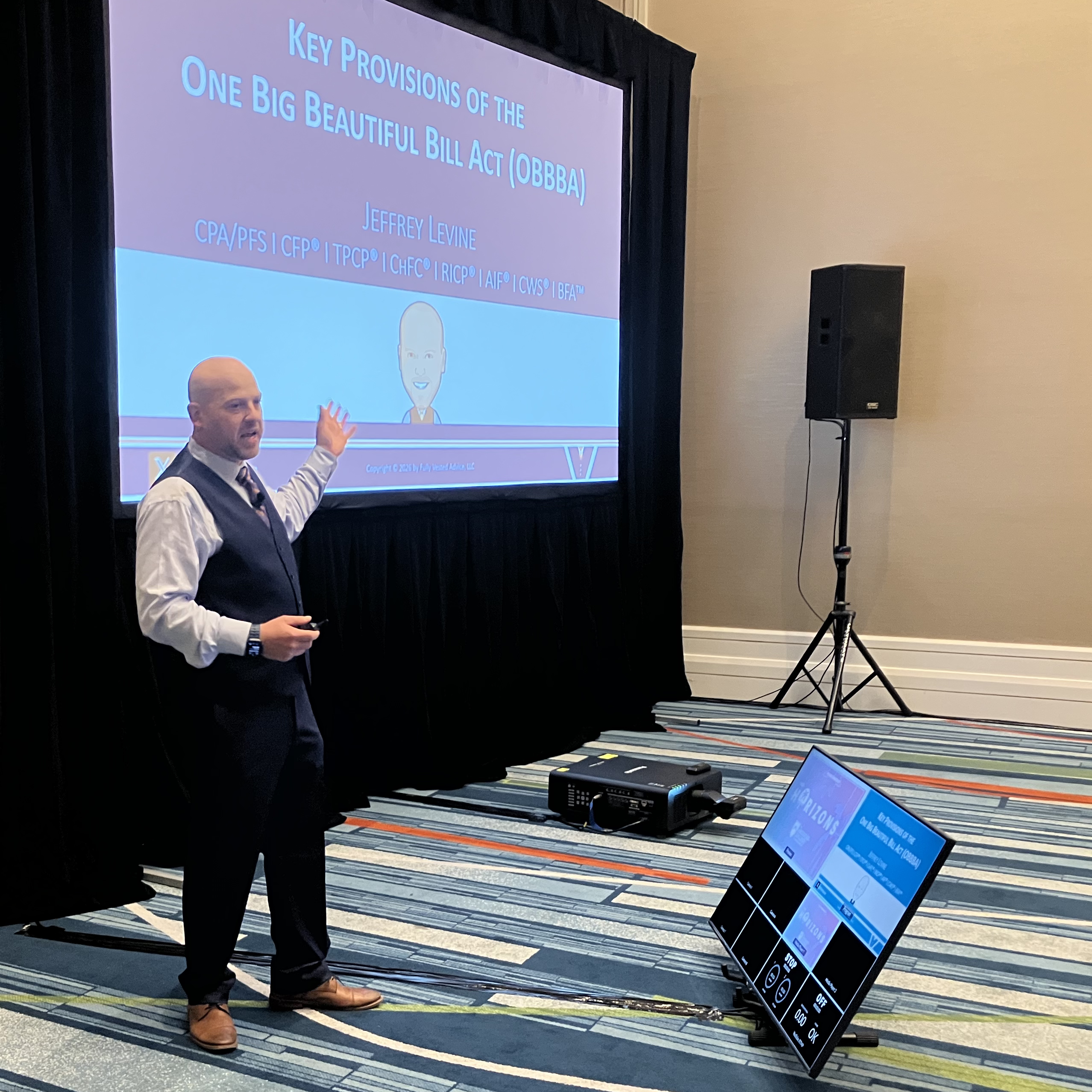
 Jeff Levine
Depending your on political leanings, the "beautiful" in the One Big Beautiful Bill Act may be debatable.
But, as Jeff Levine broke it down, one element beyond argument is that last summer's tax and spending bill is "big."
"Whether it's beautiful or not is sort of in the eye of the beholder," he said. "Maybe you love it. Maybe you hate it. But it's pretty objectively big."
Levine, the chief planning officer at Focus Partners, covered several highlights from the legislation during his session at the American College of Financial Services' Horizons 2026 retirement planning conference.
With all the changes in the bill, one thing that has remained the same is the tax brackets. The lower three (10%, 12% and 22%) received extra inflation adjustments, so the net effect was a smaller 22% tax bracket.
The "doubled" standard deduction introduced by the 2017 tax overhaul remains, with married filing jointly at $32,200, single at $16,100 and head of household at $24,150.
Miscellaneous itemized deductions remain repealed. The mortgage interest deduction is capped for interest on no more than $750,000 of principal. Some mortgage insurance premiums will be allowed to be treated as interest. Interest on home equity lines of credit generally continues to be nondeductible. Personal casualty losses continue to be limited to disaster areas. The legislation does expand eligible losses to state-declared disaster areas.
One of the major changes is the child tax credit. The nonrefundable portion increased by $2,200 for 2026, and the increased refundable portion, $1,700 for 2026, was made permanent. (Both portions are indexed for inflation.)
In the business-related provisions, the qualified business income deduction was extended, and phaseout ranges increased to $150,000, from $100,000, for joint filers and to $75,000, from $50,000, for other filers. Limitations on excess business losses were extended to $512,000 for 2026 for joint returns, and $256,000 for 2026 for other filers.
Student loan debt discharged via death or disability is now nontaxable. Also, employers may exclude up to $5,250 from compensation for payments of employees' student loans as "educational assistance."
For those with a disability, Achieving a Better Life Experience account contributions remain eligible for the Saver's Credit and 529-to-529A (ABLE account) rollovers continue to be allowed. ABLE account contribution limits remain at the annual gift tax exclusion amount. If the if the ABLE beneficiary is working, they can save an additional amount up to the lesser of their annual pay or the the federal poverty level for a one-person household.
For state and local taxes, the maximum itemized deduction increased to $40,400 for 2026 for everyone but married filing separately. That amount increased to $20,200.
One area of confusion is the "no tax on tips" and "no tax on overtime" provisions. Levine said these should be more accurately described as "no income tax on some tips" and "no income tax on some overtime." The maximum deductions for these is $25,000 for all taxpayers except married filing separately, which is $0.
Jeffrey Levine. Courtesy photo
© Arc, All Rights Reserved. Request academic re-use from www.copyright.com. All other uses, submit a request to TMSalesOperations@arc-network.com. For more information visit Asset & Logo Licensing.