JPMorgan Chase & Co. is the latest Wall Street firm to pull an about-face on the U.S. stock market, raising its S&P 500 Index target as equities continue to climb despite ongoing uncertainty about President Donald Trump’s trade policies.
The bank’s top equity strategist, Dubravko Lakos-Bujas, had predicted the U.S. stock benchmark would end 2025 at 5,200 back in April during the throes of tariff volatility.
But he now sees it closing the year at 6,000, which is a less than 1% gain from where the S&P 500 finished Thursday following a double-digit rally since its April 8 low. But it’s still downright optimistic compared to his previous expectation.
The move by JPMorgan follows similar reversals by Goldman Sachs Group Inc., Deutsche Bank AG, and Barclays Plc.
“Absent major policy surprises, the path of least resistance is to new highs,” Lakos-Bujas wrote in a note to clients late Thursday.
JPMorgan’s head of global markets strategy sees the advance supported by artificial intelligence, a steady bid from systematic strategies as volatility and momentum signals improve, and inflows from active managers buying stock-market dips.
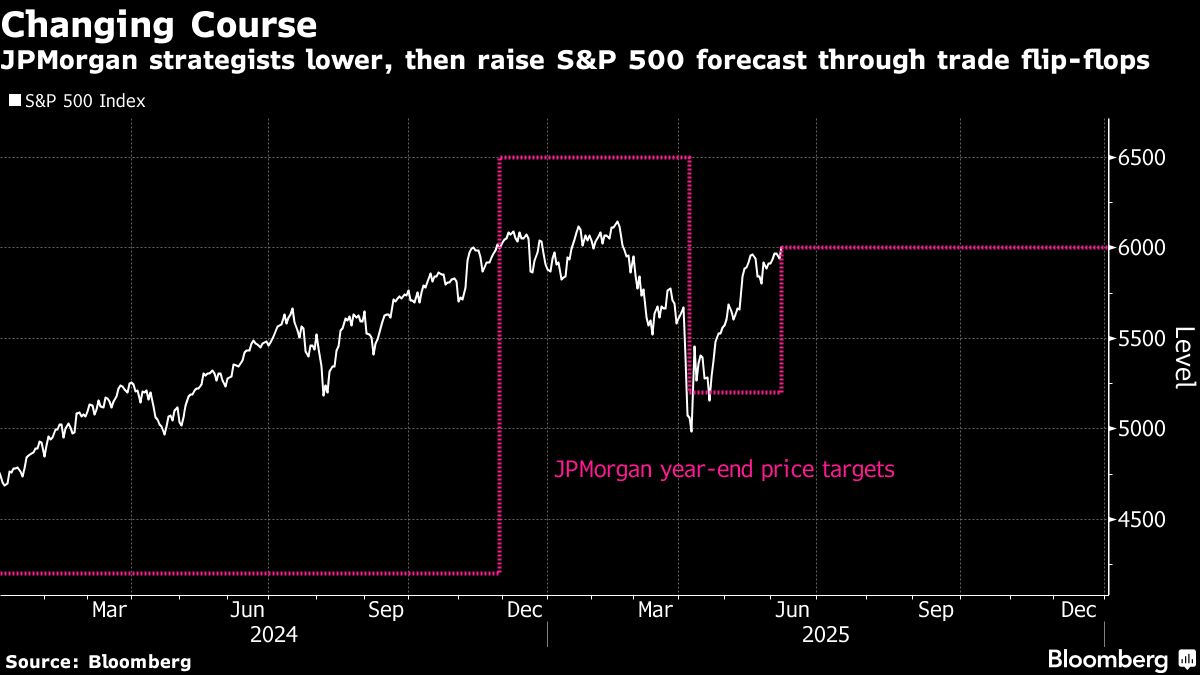
The S&P has recovered from its 12% plunge in five sessions from April 2 to April 8 after Trump unveiled his sweeping tariffs against much of the global economy.
Then, on April 9, he paused his levies for 90 days, which stopped the rout in its tracks. Since then, he’s removed some tariffs and put others on, creating an atmosphere of confusion in markets.
But without any major downside catalysts to spook investors, stocks have continued climbing, with the S&P 500 now roughly 2% from its all-time high.
Recent economic data indicates the U.S. economy has yet to feel the tariff impacts. On Friday, U.S. stocks jumped as the latest employment data came in above forecasts, showing a still-strong labor market.
Lakos-Bujas wasn’t alone in slashing his expectations during the tariff chaos in early April, which sparked fears of a trade war slowing U.S. growth. At the time, sell-side strategists were downgrading their S&P 500 forecasts at the fastest pace since the onset of the pandemic in 2020.
The flip-flops highlight the challenges of anticipating the market’s trajectory when it’s dictated by Trump’s capricious approach to economic policy.
JPMorgan sees an imminent upside squeeze, since institutional investors are now chasing the market higher after selling stocks to corporate and retail buyers during April’s panic, Lakos-Bujas wrote.
He also thinks leadership will narrow back to the high-flying Big Tech companies that have dominated the bull market.
The bank’s highest-conviction trades are momentum stocks, particularly the Magnificent Seven, semiconductors and other AI beneficiaries.
Still, Lakos-Bujas cautions that downside risks remain, including possibility of the economy slowing in the second half of the year with equity valuations elevated.
“However, if this also causes the Federal Reserve easing timeline to accelerate, the market could look through the weakness with lagging segments of the market — cyclicals, small caps — reviving, at least temporarily,” he wrote.
“Before the Bell” is a daily story with all you need to know before the open on Wall Street. On the Terminal, click here to see it and subscribe.
The “S&P Week in Review” is a wrap of equity events, published every Friday. On the Terminal, click here to see it and subscribe. The “S&P Month in Review” comes on the last day of the month. Click here to see and subscribe.
(Credit: AdobeStock)
Copyright 2025 Bloomberg. All rights reserved. This material may not be published, broadcast, rewritten, or redistributed.
© Arc, All Rights Reserved. Request academic re-use from www.copyright.com. All other uses, submit a request to TMSalesOperations@arc-network.com. For more information visit Asset & Logo Licensing.