U.S. stocks rallied Monday, with everything from Big Tech to retail and travel shares advancing after Washington and Beijing agreed to temporarily suspend most tariffs on each other’s goods, boosting investor optimism on the global economy and corporate profits.
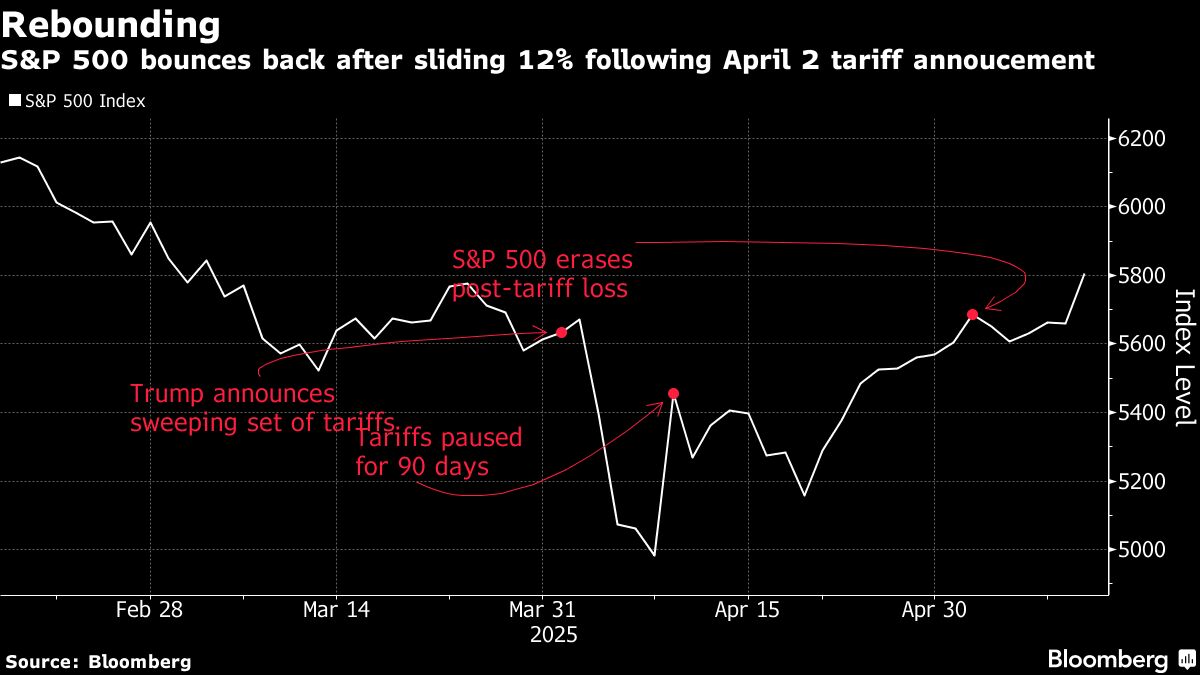
The S&P 500 Index rallied 2.3% as of 10:38 a.m. in New York, on track for its best session since April 9 to put it on course to close above where it stood on April 2, when President Donald Trump first announced his tariff blitz.
The Nasdaq 100 Index jumped 3.2%, nearly erasing its year-to-date drop and was on track to re-enter a bull market, with Nvidia Corp., Amazon.com Inc. and Meta Platforms Inc. all rising.
Apple Inc., which does much of its manufacturing in China, and Tesla Inc., which generates a substantial portion of its sales in China, both jumped more than 5%.
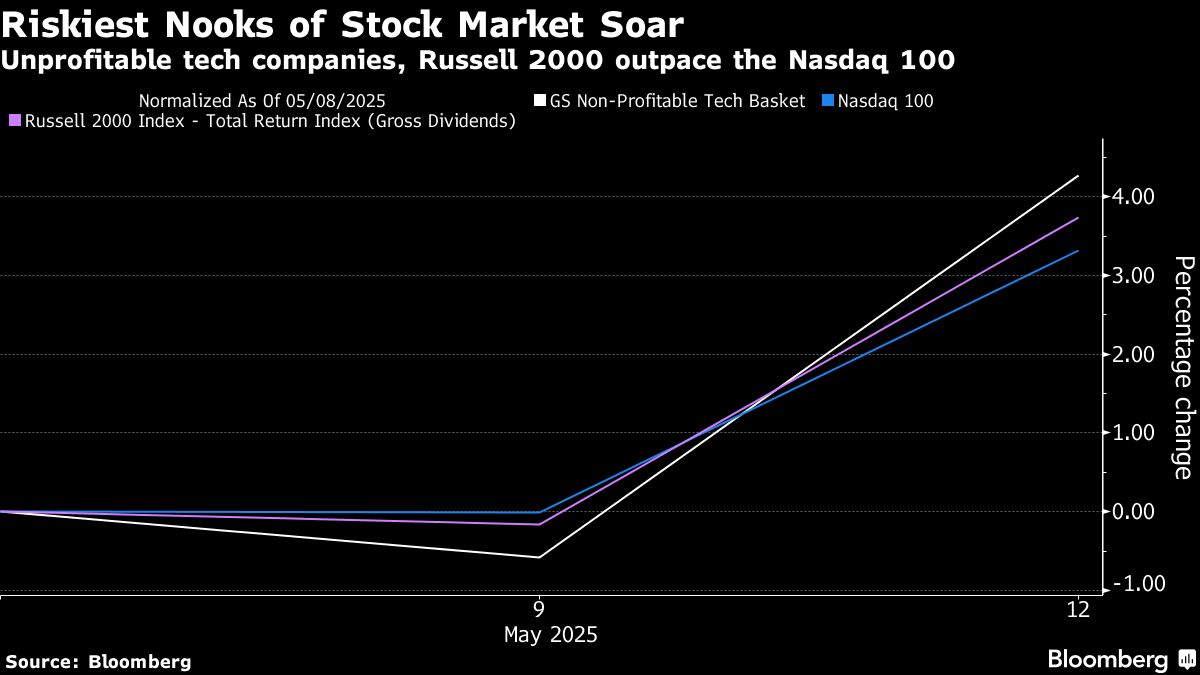
Traders bought into the riskiest parts of the stock market after Treasury Secretary Scott Bessent hailed the trade discussions as “very robust and productive” while further negotiations between the world’s two largest economies continue, with the small-capitalization Russell 2000 Index leaping 3.8%.
A Goldman Sachs basket of unprofitable tech companies, which includes firms like Roku Inc. and Peloton Interactive Inc., gained 4.9% while the most shorted companies jumped 5.7%.
Travel and consumer companies with large China exposure also climbed. Nike Inc. soared 7.8% while Estee Lauder Companies Inc. climbed 9.7%. Dollar Tree Inc., Wayfair Inc., Under Armour Inc. and Foot Locker Inc. all advanced.
U.S. airlines rose, with Delta Air Lines Inc., United Airlines Holdings Inc. and American Airlines Group Inc. all higher while cruise stocks also advanced, led by gains in Royal Caribbean Cruises Ltd., Carnival Corp. and Norwegian Cruise Line Holdings.
“Investors and money managers are taking the worst case recession scenarios from the trade war off the table,” said Thomas Martin, said senior portfolio manager at Globalt Investments. “We’ll see how this goes over the coming weeks, but trade developments are certainly moving in the right direction.”
Global stock markets surged overnight after U.S. and China announced they were suspending for 90 days most of the sharp tariff hikes each has imposed since Trump began escalating his trade war and will temporarily lower tariffs on each other’s products that buys both economies three months to work toward a broader agreement, according to a joint statement and from officials in a briefing Monday in Geneva.
The prospect of lower tariffs opens the possibility that the worst damage to the economy may be largely averted, leaving the S&P 500 just 5.5% below its February peak.
Wall Street’s chief fear gauge, the Cboe Volatility Index, or the VIX, fell below 20 — its lowest level since late March. The U.S. dollar rallied against the Japanese yen, trading at 147.86 Japanese yen, up from 146.17 yen.
Oil prices rallied, with US benchmark crude gaining 3.5% to $63.14 per barrel. Brent crude, the international standard, added 3.3% to $65.97 per barrel.
“We would be a buyer of any near-term weakness,” the team led by Andrew Tyler, global head of market intelligence at JPMorgan Chase & Co., said in a note.
“But potential upside would be anything that addresses rare earth/ semi-conductor trade, a reduction on shipping fees, or a lower than 60% tariff level while a longer-term deal is negotiated.”
That said, pharmaceutical stocks fell, led by declines in Eli Lilly & Co., Pfizer Inc., Bristol-Myers Squibb Co. and Merck & Co. Inc. after Trump said he planned to order a cut in U.S. prescription costs to bring them in line with other countries, prompting concern that profits will take a hit. U.S. listed shares of Novo Nordisk A/S, AstraZeneca Plc and Roche Holding AG also slid.
The Philadelphia Stock Exchange Semiconductor Index, which houses Nvidia, Advanced Micro Devices Inc. and Micron Technology Inc. jumped 6.8%. And US-listed Chinese stocks rose, thanks to gains in Alibaba Group Holding Ltd., JD.Com Inc. and Baidu Inc.
The combined 145% U.S. levies on most Chinese imports will be reduced to 30% by May 14, while the 125% Chinese duties on U.S. goods will drop to 10%.
Safe-haven assets that investors had snapped up after Trump unveiled his tariff plans on April 2 fell out of favor Monday as traders reassessed the risks of a global trade war and recession fears. The yield on 10-year Treasuries rose to 4.46%.
Gold, which hit an all-time high of $3,500 last month, tumbled, with precious metals and mining stocks like Barrick Mining Corp. and Coeur Mining Inc. sliding.
Trump’s aggressive trade policies had spurred worries for U.S. corporate earnings, with investors entering this week nervous about a profit update from retail giant Walmart Inc. on Thursday, kicking off retail earnings after a slew of U.S. multinationals like Delta Air Lines Inc. and General Motors Co. pulled their forecasts.
Some analysts cautioned that this was not the end of unpredictable trade talks between the White House and Beijing and that any relief may soon be overshadowed by data showing the U.S. economy is slowing. In an interview on Bloomberg Television, Bessent said it would be “implausible” for US tariffs on China to go below 10%.
“While the China and U.S. framework is good news, those who are hung up on the uncertainty will likely hang on the 90-day reprieve versus progress,” said Matt Lloyd, chief investment strategist at Advisors Asset Management. “There are some economic hard data points that will still need to be reconciled for a longer upward trajectory, but sentiment will likely improve.”
Credit: Adobe Stock
Copyright 2025 Bloomberg. All rights reserved. This material may not be published, broadcast, rewritten, or redistributed.
© Arc, All Rights Reserved. Request academic re-use from www.copyright.com. All other uses, submit a request to TMSalesOperations@arc-network.com. For more information visit Asset & Logo Licensing.