Stocks got hammered, bonds climbed and gold hit a record high, following signs of weakness in the main engine of the U.S. economy and worries that inflation could gain further traction amid a trade war.
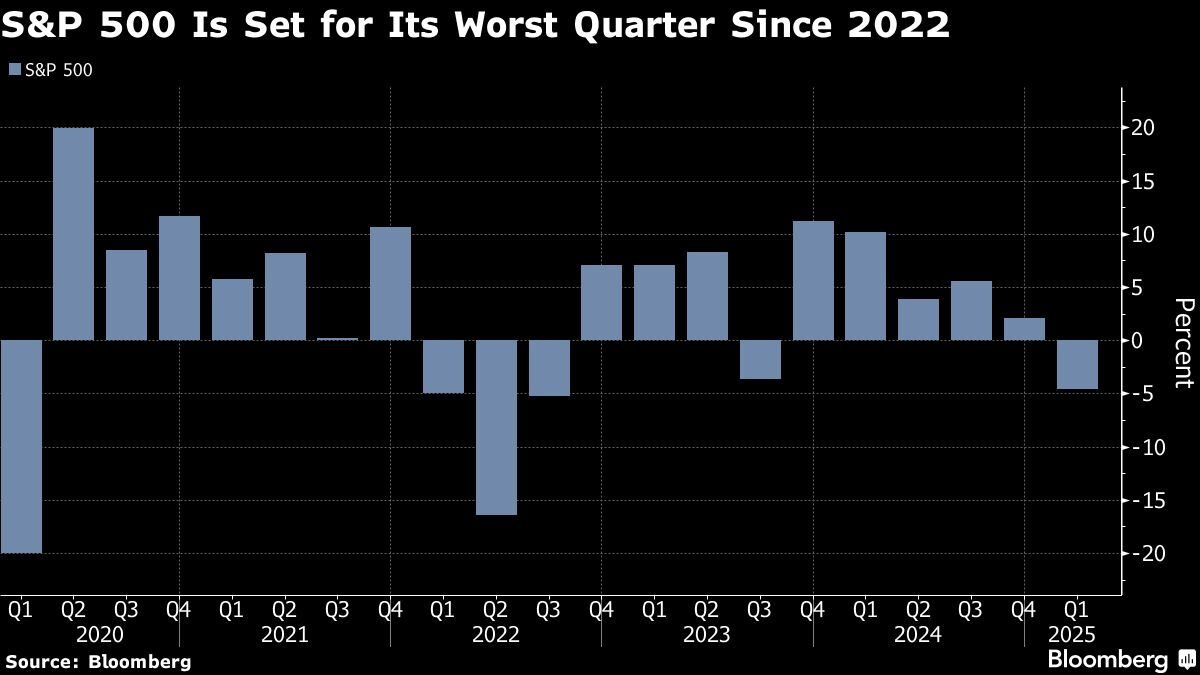
With just one more session left before the end of a quarter that’s set to be the S&P 500’s worst since 2022, the gauge fell 2%. Data showed a plunge in U.S. consumer sentiment and a surge in long-term inflation expectations.
That was after another report underscored tepid spending and a pick-up in prices ahead of next week’s big U.S. tariff rollout. A gauge of tech megacaps slumped 3%. The yield on 10-year Treasuries sank 10 basis points to 4.26%.
To Bret Kenwell at eToro, the biggest worry is that inflation will remain elevated amid a notable slowdown in the economy.
“And while that risk may not be the base case right now, any traction it gains could further weigh on investor sentiment,” he said. “But unless there’s a larger deterioration in the economy, it’s too soon to jump on the stagflation train.”
The S&P 500 slid 2%. The Nasdaq 100 lost 2.6%. The Dow Jones Industrial Average slipped 1.7%. All megacaps sank, with Amazon.com Inc. and Alphabet Inc. sinking over 4%. Lululemon Athletica Inc. tumbled 15% after giving a gloomy outlook and voicing concerns about consumer spending.
Bond traders continue to anticipate at least two Federal Reserve rate cuts this year. The dollar wavered. Canada’s loonie rose as President Donald Trump said he spoke with Canadian Prime Minister Mark Carney amid trade tensions. Bitcoin tumbled 4%.
As Trump’s tariff policy expands, consumers are growing more worried that the added duties will drive up prices. A prolonged rise in costs could prompt households to cut back on discretionary spending, which has implications for broader economy — and Corporate America.
“Today’s data has the general pattern of what many observers will be looking for in the months ahead as new tariffs and other policy change begin to bite: weaker-than-expected spending and stronger-than-expected inflation,” according to David Alcaly at Lazard Asset Management.
While it’s premature to be drawing judgments, but seeing this pattern in hard data and not just surveys could feed apprehension before next week’s announcements, Alcaly added.
“When you don’t know what’s coming, it’s harder to plan,” said Jim Baird at Plante Moran Financial Advisors. “In the face of growing uncertainty, consumers are left with tough decisions. For now, inflation has re-emerged as a significant – and growing – concern for consumers.”
Economists dialed back their expectations for U.S. growth this year, envisioning softer consumer spending and more limited capital investment amid mounting uncertainty created by the ever-evolving trade policy.
Gross domestic product is now set to grow 2% in 2025, according to the latest Bloomberg survey of economists. Inflation, meanwhile, will stay above the Fed’s 2% goal.
(Credit: Shutterstock)
Copyright 2025 Bloomberg. All rights reserved. This material may not be published, broadcast, rewritten, or redistributed.
© Arc, All Rights Reserved. Request academic re-use from www.copyright.com. All other uses, submit a request to TMSalesOperations@arc-network.com. For more information visit Asset & Logo Licensing.