Anxiety that tariffs and government firings will torpedo growth in the world’s largest economy extended a three-week stretch of volatility across global markets. American stocks got hammered as Wall Street tempered bullish views while demand for recession havens boosted sovereign bonds.
A selloff in the S&P 500’s most influential group — big tech — weighed heavily on trading. The gauge came within a striking distance of a correction, extending its plunge from a record to 8.6%.
The Nasdaq 100 saw its worst day since 2022. A gauge of the Magnificent Seven megacaps tumbled 5.4%.
Treasury yields slid on bets that an economic slowdown would force the Federal Reserve to slash interest rates. Bitcoin slipped below $80,000.
Speculation is intensifying that President Donald Trump is willing to tolerate hardship in the economy and markets in pursuit of long-term goals involving tariffs and smaller government.
Asked on Fox News’ Sunday Morning Futures whether he’s expecting a recession, he said, “I hate to predict things like that. There is a period of transition, because what we’re doing is very big.”
“We’ve gone from animal spirits to what are the odds of a recession,” said Gina Bolvin, president of Bolvin Wealth Management Group. “This is a headline-driven market; one that could change in an hour. Sit tight. Buckle up. We finally have the correction we were waiting for, and long-term investors will be rewarded again.”
“There’s a saying on Wall Street about how nothing good happens below the 200-day moving average,” said Callie Cox at Ritholtz Wealth Management. “Honestly, out of all the crazy sayings that come out of this industry, it’s one you should take seriously. Selloffs accelerate and swings get dramatically bigger in the danger zone — or the space below the 200-day moving average.”
The S&P 500 dropped 2.7%. The Nasdaq 100 lost 3.8%. In the megacap space, Tesla Inc. sank 15% while Nvidia Corp. drove a closely watched gauge of chipmakers toward the lowest since April. The Dow Jones Industrial Average lost 2.1%.
The yield on 10-year Treasuries slid eight basis points to 4.22%. The dollar rose 0.2%. About 10 high-grade companies delayed US corporate bond sales on Monday. West Texas Intermediate dipped to trade below $66 a barrel, down more than 15% from its mid-January peak.
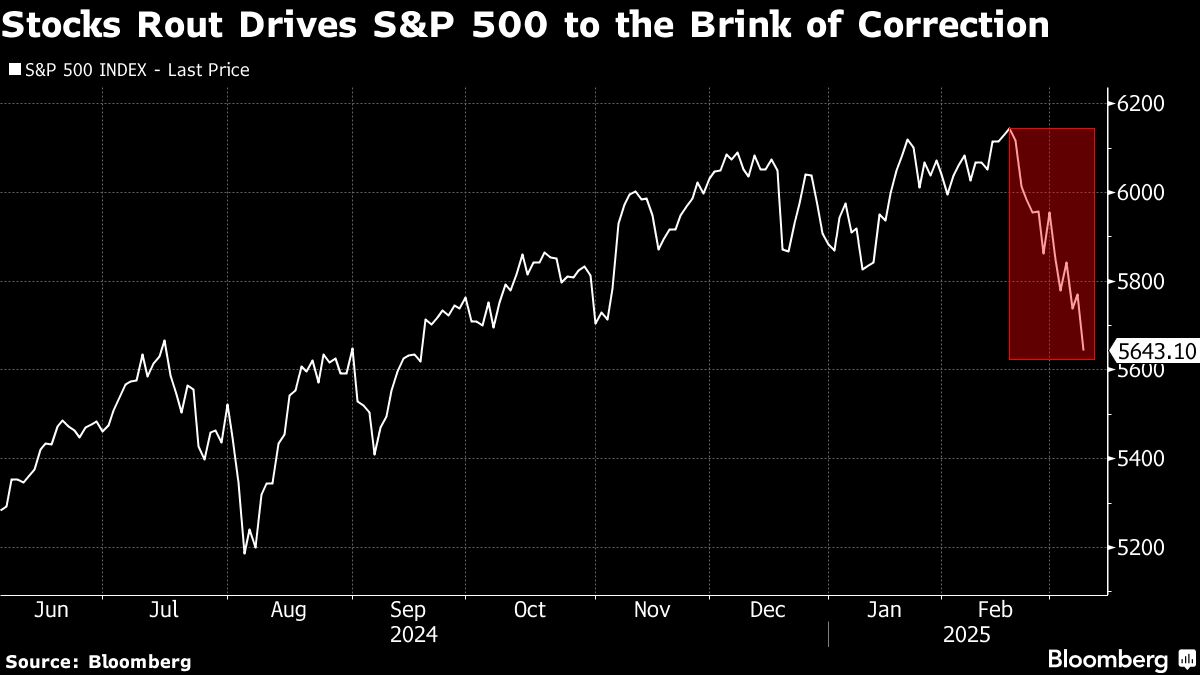
The S&P 500 dropped 2.7%. In the megacap space, Tesla Inc. sank 13% while Nvidia Corp. drove a closely watched gauge of chipmakers to the lowest since August. The Dow Jones Industrial Average lost 1.8%. Wall Street’s closely watched volatility gauge - the VIX - hit the highest this year.
The yield on 10-year Treasuries slid eight basis points to 4.22%. The dollar rose 0.2%. US credit risk soared, and over 10 high-grade companies delayed bond sales. West Texas Intermediate dipped to trade below $67 a barrel, down more than 15% from its mid-January peak.
The latest moves mark an abrupt about-face for markets, where the dominant driver of the last few years had been the surprising resilience of the US economy even as growth weakened overseas. That’s shaking the aura of economic and market exceptionalism that has dominated for more than a decade.
“This is a period of high uncertainty on a global macro scale - and as a result, we continue to see de-risking in U.S. stocks,” said Dan Wantrobski at Janney Montgomery Scott. “Added to the potential geopolitical disruptors are the ongoing narratives of inflation, growth, and now potential recession (exacerbated by tariff wars) in the U.S.”
Tariff Troubles
The talk of tariffs is in a lot of ways worse than the implementation of them, according to David Bahnsen, chief investment officer at The Bahnsen Group,
“I do not believe the administration knows how the tariff situation will play out, but if I were a betting man, I would say that it will persist long enough to do damage to economic activity for at least a quarter or two, and ultimately result in a deal with different countries that make everyone wonder why we went through all the fuss,” Bahnsen said.
He also noted that if a tax cut extension and further tax reform bill is passed through budget reconciliation sooner than later, that will help “offset the damage.”
A chorus of Wall Street strategists is warning about higher stock volatility, with Morgan Stanley’s Michael Wilson the latest to sound the alarm on economic growth worries.
Other market forecasters including at JPMorgan Chase & Co. and RBC Capital Markets have also tempered bullish calls for 2025 as Trump’s tariffs stoke fears of slowing economic growth.
“There are always multiple forces at work in the market, but right now, almost all of them are taking a back seat to tariffs,” said Chris Larkin at E*Trade from Morgan Stanley. “Until there’s more clarity on trade policy, traders and investors should anticipate continued volatility.”
To Sam Stovall at CFRA, how long this period of investor caution persists depends on how quickly it will take the global trade clouds, and the resulting threat of recession, to dissipate.
“Markets continue to prove sensitive to trade policy, as considerable uncertainty remains over the size and scope of tariffs to be implemented,” said Jason Pride and Michael Reynolds at Glenmede.
“Just as important may be how long the tariffs stay on. Are they temporary in order to extract concessions, or are they a new permanent fixture of U.S. trade policy?" Reynolds asked.
From rookie retail traders to hedge fund pros, no one knows what the eventual cost of Trump’s sweeping policies really are. His pro-growth plans were tax cuts, deregulation and energy dominance.
Tariffs were supposed to bring manufacturing back to the US and create jobs. But so far there’s little evidence of that.
All of this has mom-and-pop investors spooked. For the first time since 2022, the majority of individual investors say they believe stock prices will drop over the next six months, according to a survey by the American Association of Individual Investors. Fewer than 20% say they expect prices to rise over that period.
“Here again we would reiterate that despite sentiment indicators like the AAII bull/bears numbers showing excessive bearishness from retail (newsletter writers), actual positioning of both Main Street and institutional investors remains skewed toward long equities,” said Wantrobski.
“This implies that there could be more firepower to unwind if our unstable macro landscape persists in the coming weeks/months,” he added.
Mark Hackett at Nationwide says he has greater confidence that we are near a bottom rather than on the cusp of a new wave of selling.
“We do need to keep an eye on the pessimistic scenario though, where labor market fears and consumer pullbacks could lead to stagflation, but the proof will be in the datapoints that come out over the next few weeks,” he noted.
“If key risks like the debt ceiling, government shutdown, and tariffs resolve in a better-than-worst-case scenario, and economic data remains stable, we could see a recovery follow this selloff,” Hackett added.
Selling pressure coming from so-called systematic funds, which take cues form the market direction rather than fundamentals, could soon ebb, according to Goldman Sachs Group Inc.’s trading desk. Meanwhile, TD Securities and Citigroup Inc. say it’s already happening.
The actions of this set of quick-twitch, algorithm-driven investors is important because their aggressive offloading of shares has been a headwind contributing to the market’s tumble of late.
TD says that selling across systematic funds may already have peaked, with commodity trading advisers, or CTAs, capitulating on the majority of their long positions.
(Photo: Michael Nagle/Bloomberg)
Copyright 2025 Bloomberg. All rights reserved. This material may not be published, broadcast, rewritten, or redistributed.
© Arc, All Rights Reserved. Request academic re-use from www.copyright.com. All other uses, submit a request to TMSalesOperations@arc-network.com. For more information visit Asset & Logo Licensing.