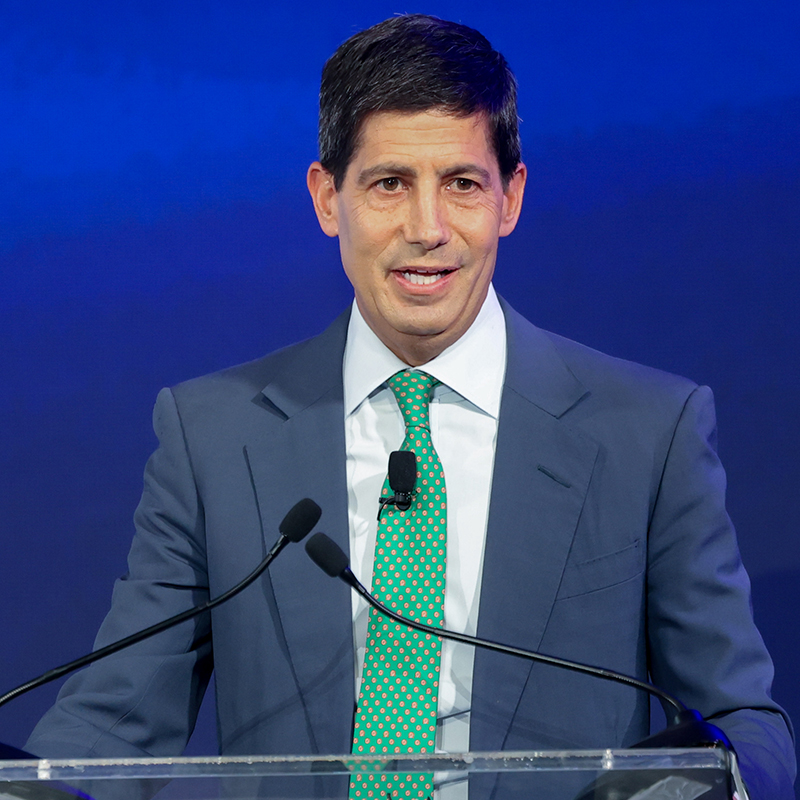
 Kevin Warsh, President Trump's pick to head the U.S. Federal Reserve starting in May, speaking at the International Monetary Fund (IMF) and World Bank Spring meetings at the IMF headquarters in Washington, D.C., on April 25, 2025.
The Senate narrowly confirmed Kevin Warsh as chair of the Federal Reserve, setting up the most controversial leadership transition at the U.S. central bank in decades and a test of its political independence.
The 54-45 vote Wednesday was the slimmest confirmation margin ever for a head of the central bank, reflecting polarized politics in Congress and Democratic fears that Warsh will bend to President Donald Trump's demands to rapidly lower interest rates.
Only one Democrat, John Fetterman of Pennsylvania, crossed party lines to back Warsh to succeed Jerome Powell. The incoming chairman's vote margin came in under Janet Yellen's 56-26 tally in 2014.
Bipartisan support for Fed picks used to be the rule, rather than the exception, with Alan Greenspan even winning unanimous support to continue as Fed chair in 2000.
The Senate voted hours after a government report on wholesale prices heightened concerns about accelerating inflation. The producer price index in April rose 6% from a year ago, topping all estimates in a Bloomberg survey of economists. A core measure of wholesale inflation that excludes food and energy was up 5.2%, suggesting the war-driven increase in energy costs is spreading to other goods.
Persistent inflation worsened by the Iran war oil price shock poses a challenge for policymakers. Consumer price data released Tuesday showed gas prices, groceries, rents and airfares all rose quickly in April.
Warsh, 56, who's advised Trump on economic policy but was passed over for the top Fed job in 2017 when the president opted for Powell instead, is now set to replace Powell, whose term as chair ends Friday.
The main question looming over the incoming chair is whether he'll maintain the Fed's tradition of making interest-rate decisions free from political pressure, with less than six months until Trump's Republican congressional majority is on the line in midterm elections.
Warsh vowed during his confirmation hearing that the Fed's monetary policy would remain "strictly independent" under his leadership. But Trump, who lambasted Powell repeatedly for not cutting rates fast enough, has made it clear he expects Warsh to lower borrowing costs immediately.
An increasing number of Fed officials are arguing the US central bank should signal explicitly that the Fed's next rate move could be either a cut or a hike. For Warsh, this suggests he'll face fierce resistance if he attempts to steer the Fed toward rate reductions that officials don't see as justified.
Warsh also has suggested he would seek to shrink the Fed's $6.7 trillion balance sheet over time, and argued during his confirmation hearing that interest rate cuts are fairer than balance sheet expansion because the benefits are more broad-based.
He faulted the Fed's performance on fighting inflation during the Biden years, suggesting the Fed lost focus on its core mission.
Warsh's confirmation has been on a glide path since Senator Thom Tillis, a North Carolina Republican last month lifted his blockade on Fed nominations. Tillis acted after the Department of Justice announced it had ended a criminal inquiry of Powell related to cost overruns in the Federal Reserve's building renovations.
Tillis, Powell and many Democrats portrayed the criminal investigation of the current Fed chair as an attempt by the Trump administration to pressure him to lower interest rates more quickly.
Democrats also remain angry over Trump's efforts to fire Fed Governor Lisa Cook, which they see as part of a campaign to intimidate the central bank.
Powell said in April he will remain on the central bank's board after his term as chairman ends but maintain "a low profile." He said he decided upon the course, a break with recent precedent, because ongoing threats of criminal investigations into him and the central bank endanger the Fed's autonomy.
Credit: Tierney L. Cross/Bloomberg
Copyright 2026 Bloomberg. All rights reserved. This material may not be published, broadcast, rewritten, or redistributed.
© Arc, All Rights Reserved. Request academic re-use from www.copyright.com. All other uses, submit a request to TMSalesOperations@arc-network.com. For more information visit Asset & Logo Licensing.