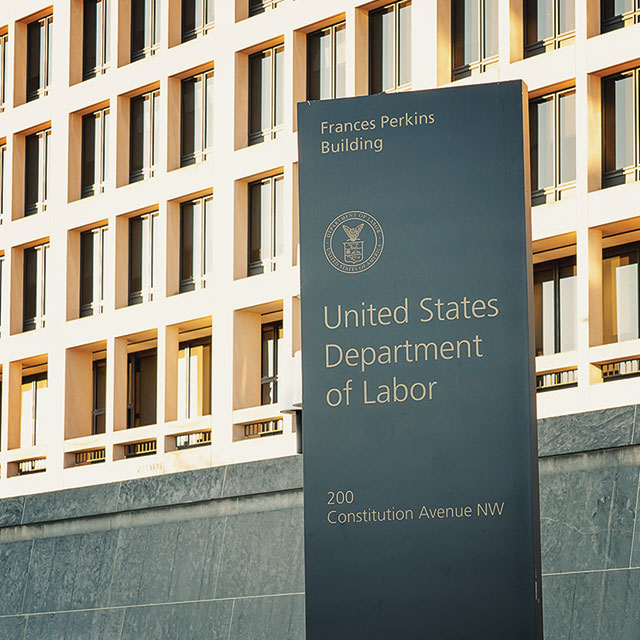
The Federation of Americans for Consumer Choice has dropped its lawsuit against the Labor Department challenging the agency's guidance issued in 2020 on who is considered a fiduciary when giving rollover advice.
The FACC lawsuit pending against Labor in a Texas federal court, which challenged the 2020 fiduciary guidance stating that one-time rollover advice was fiduciary advice, "was rendered moot" by DOL's vacatur in mid-March of portions of the preamble to Prohibited Transaction Exemption 2020-02 on rollover advice, FACC said Monday.
"PTE 2020-02 is an exemption for non-discretionary advice — it allows variable compensation or commissions for advice (including rollovers) if the financial professional and the financial institution related to the financial professional both accept fiduciary status, make certain disclosures, follow certain conduct standards, and receive only reasonable compensation," Brad Campbell, partner at Faegre Drinker in Washington, said Monday. "That part — the exemption itself — is not affected by the FACC litigation, and has been widely used since 2020."
However, in 2020, "DOL decided to throw some otherwise unrelated fiduciary rollover interpretive guidance into the Preamble to PTE 2020-02 — the guidance isn't needed to use the exemption, DOL just used the Preamble as the vehicle to issue the guidance," Campbell explained. "What the guidance did is explain — in a new way that materially changed things — how to apply each of the five factors of the 1975 fiduciary rule in the five-part test."
FACC sued Labor, alleging that the new guidance was not correctly interpreting the 1975 regulation.
Dismissal of FACC's lawsuit comes on the heels of two court orders in early March vacating Labor's 2024 fiduciary rule, and Labor's March 20 Notice of Vacatur "to restore the agency's historical five-part test for determining who is a fiduciary," said FACC, which represents independent insurance agents who sell annuities and other income planning products.
FACC and Labor "entered into a stipulation to dismiss the lawsuit without prejudice which ends the four year old case but preserves FACC's ability to sue again on the same or similar grounds in the future," Kim O'Brien, FACC's CEO, said Monday in a statement.
"It may seem anti-climactic but we really see this as a red-letter moment because the stipulation brings an end to a very long chapter of uncertainty for our industry," she said. "Even though the DOL on its own already had acted to withdraw the 2020 guidance, the stipulation is significant because it memorializes and cements the DOL's position on these issues."
Labor intends to reinstate the 2005 Deseret advisory opinion, "which had been intertwined with the controversy over who is a fiduciary," FACC said. "The so-called Deseret Letter reflected the DOL's position that giving advice to roll assets out of an employer plan, even when combined with a recommendation to purchase an IRA, would not ordinarily cause a financial provider to be considered a fiduciary."
"We are left with the 1975 regulation and its 5-part test for fiduciary status and with the 2020 version of PTE 2020-02 (although the DOL stripped its preamble from the PTE)," added Fred Reish, of counsel with the Ferenczy Benefits Law Center, on Monday in an email.
Credit: Adobe Stock
© Arc, All Rights Reserved. Request academic re-use from www.copyright.com. All other uses, submit a request to TMSalesOperations@arc-network.com. For more information visit Asset & Logo Licensing.