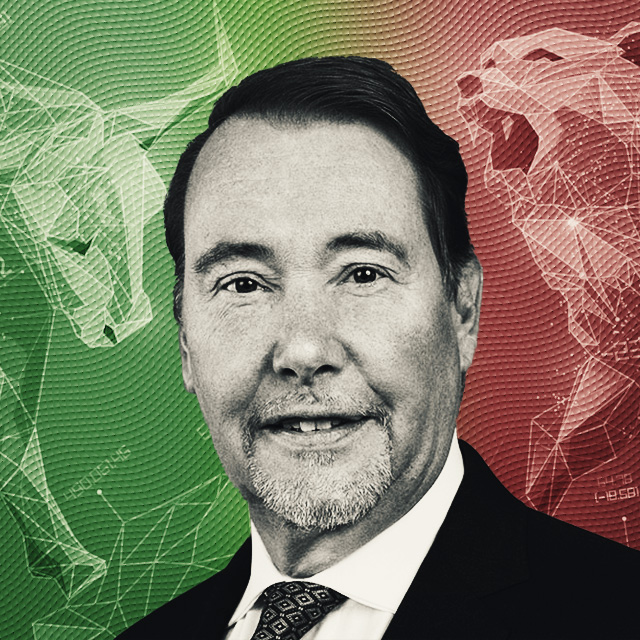
The Federal Reserve is unlikely to cut interest rates this year and may be more likely to modestly raise them, DoubleLine Capital CEO Jeffrey Gundlach said Wednesday after the U.S. central bank kept its benchmark rate at a 3.5% to 3.75% target range.
While the market earlier this year indicated expectations for two rate cuts in 2026, the billionaire investor noted, the bond market now projects virtually no cut this year, he said in a DoubleLine webcast.
The 2-year Treasury yield determines where the federal funds rate will go, Gundlach said, noting that it now sits higher than that rate. He placed the current Fed benchmark rate at 3.625%; the 2-year Treasury yield stood over 3.7%, he noted.
Gundlach cited "general sentiment that without Fed rate cuts, there's very little fuel to propel risk markets. Therefore, investors should stay with the game plan we've talked about in past appearances after the Fed meeting, and that is high in quality. ... It's still not overly late to continue to move upward in credit. Avoid the long end of the bond market," even though it's been stronger lately because of the Iran war, he said.
"I continue to recommend non-U.S. investing in equities, which I've been recommending since January of 2025. That has definitely worked and I think will continue to work as the deficit in the United States, the budget deficit continues to grow at about a $2 trillion per year annual rate," Gundlach added.
The national debt has surpassed $39 trillion, "so we'll be at over $40 trillion by the end of 2026. That's something that you can take to the bank, unlike perhaps the projections on inflation," he said.
"Year to date, the only things that are up in financial markets, basically for U.S. investors are gold, which is still up 12.3% year to date. The Bloomberg Commodity Index, amazingly, is up 23 and change year to date. Obviously oil has a big role in that. So does gold. Bitcoin is a loser again this year. It's down 18.5% year to date," Gundlach said, noting also that emerging market stock ETFs are up and, by a small amount, the dollar.
"Pretty much everything else is down," including the Dow Jones Industrial Average, the S&P 500 and Nasdaq, Gundlach noted.
"So that's where we stand. I think the the phrase that Jay Powell mentioned was, if we don't see the progress on inflation, then we won't see the rate cut. That's when stocks started to kind of give up ground. I thought that they would on that statement. I'll say that one more time because I think it's the most memorable thing from the press conference" other than Powell repeatedly saying "We don't know" how the Iran war will affect the U.S. economy, he added.
Gundlach agreed with Fed Chairman Jerome Powell's assertion that inflation expectations remain anchored. The bond market and consumers indicate that virtually everyone expects inflation to be higher this year than last, "but there's still a belief that inflation can come back down below 2.5% in the relatively near term," he said.
"If those expectations go up to 3%, and certainly if they surpass 3% by these various metrics, the Fed will have to hike interest rates. And I think that's why the fed funds rate is now a little bit lower," Gundlach said.
The Fed raised its 2026 inflation assessment to 2.7% from 2.4%, and likely did so because they had to and would have lost all credibility if they'd kept it the same after a nearly $40-a-barrel increase in crude oil prices versus year-end 2025, due to the Iran war, the CEO said. "That should lead to a quite significant increase in headline inflation."
Illustration: Chris Nicholls/Touchpoint Markets; courtesy photo
© Arc, All Rights Reserved. Request academic re-use from www.copyright.com. All other uses, submit a request to TMSalesOperations@arc-network.com. For more information visit Asset & Logo Licensing.