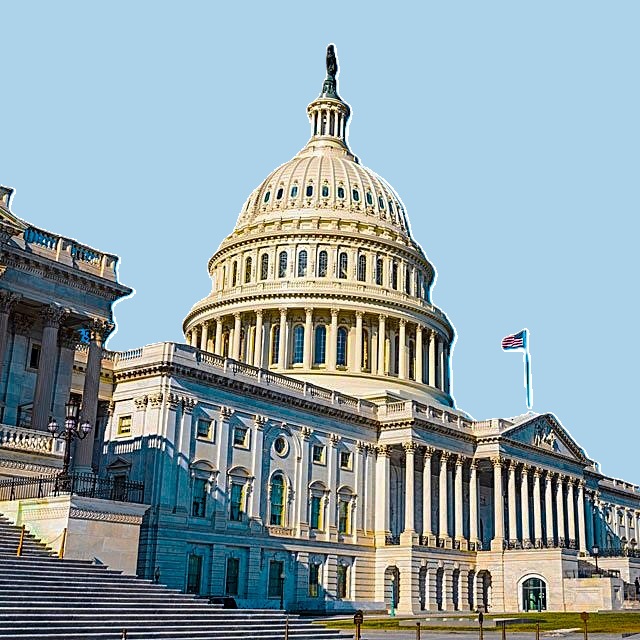
 The U.S. Capitol. Credit: Shutterstock
The U.S. House passed a bill Monday that could help especially big or important life insurance and annuity issuers fend off Federal Reserve Board supervision.
Lawmakers agreed by a voice vote to send H.R. 3682, the Financial Stability Oversight Council Improvement Act of 2025, to the Senate.
The FSOC Improvement Act bill would give an insurer, an asset manager, a cryptocurrency exchange manager or another "nonbank financial company" some protection against the Fed swooping in when FSOC thinks financial problems at the company could hurt the stability of the U.S. financial system.
If FSOC wanted to put a nonbank financial company under Fed supervision due to worries about systemic risk, FSOC would have to start by talking to the company and its usual regulator.
Before FSOC could put the company under Fed supervision, FSOC would have determine that any alternative proposed "is impracticable or insufficient to mitigate the threat," according to the bill text.
The bill would reform FSOC by strengthening FSOC's transparency and accountability, according to an announcement the House Financial Services Committee put out when the bill passed.
"It ensures regulated entities receive clearer guidance, improved due process, and greater oversight when FSOC exercises its authority," the committee said.
What it means: If the FSOC Improvement Act becomes law, U.S. financial regulators would have to listen to a company and consider its ideas before turning it over to Fed officials.
Critics say any law that reduces the Fed's authority to regulate systemic risk at nonbank companies could limit the Fed's ability to manage a serious financial crisis.
Supporters of the proposed consultation requirement say it could reduce the risk that the Fed will respond to concerns in a way that causes unnecessary harm to the customers.
The legislation: Rep. Bill Foster, D-Ill., introduced H.R. 3682 with support from 11 Democratic co-sponsors and nine Republican co-sponsors.
The House Financial Services Committee endorsed the bill in September 2025 by a 47-4 vote.
The companion bill in the Senate, S. 3578, was introduced by Sen. Mike Rounds, R-S.D. That bill has two Democratic co-sponsors and one Republican co-sponsor.
The backdrop: Congress created FSOC in the wake of the 2007-2009 financial crisis.
FSOC — pronounced "F-sock" — is supposed to help U.S. regulators track and solve problems that could hurt the U.S. financial system.
By law, the chairman of FSOC is the U.S. Treasury secretary.
Most of the other members are the heads of agencies such as the Federal Reserve Board, the Federal Deposit Insurance Corp. and the U.S. Securities and Exchange Commission.
FSOC designers have coped with the fact that the United States lacks a federal insurance regulatory agency by making one individual "with insurance expertise" a voting FSOC member. A representative for state insurance regulators and the head of the Treasury Department's Federal Insurance Office serve as non-voting members.
Insurance companies are heavily regulated by state insurance commissioners, Insurers say bankers who try to regulate insurers tend to pay too much attention to "runs," or the unlikely possibility that customers could rush in to pull cash out and too little to attention to the difficulty of making good on benefits obligations.
Life and annuity issuer executives contends that runs are much less likely to hurt life insurers than to hurt commercial banks, because life and annuity issuers use many contractual requirements to limit the customers' access to contract value and slow the release of any value that the customers do pull out.
Other types of nonbank financial companies, such as asset managers and managers of cryptocurrency programs, have also expressed concerns about the possibility of FSOC putting them under Fed supervision.
In the mid-2010s, big life insurers saw the possibility of being "designated as a systemically important financial institution" by FSOC and placed under Fed oversight as a major business risk. They all restructured their operations, went to court or took other steps to escape from being classified as SIFIs.
Reactions: The American Council of Life Insurers, Finseca and the Insured Retirement Institute have joined in the effort to support the bill.
The list of organizations supporting H.R. 3682 also includes property and casualty insurance groups, the Alternative Investment Management Association, the Investment Adviser Association, the Investment Company Institute, SIFMA, the Digital Chamber and the U.S. Chamber of Commerce.
Mike Flood, a senior vice president at the U.S. Chamber of Commerce, said in a statement that companies designated as SIFIs face steep regulatory requirements.
Enacting H.R. 3682 will ensure that designation of a nonbank company as systemically important "is reserved as a tool of last resort," Flood said.
Jill Kozeny, the ACLI's chief advocacy officer, welcomed House passage of H.R. 3682, predicted in an email that enacting the bill would bring "much-needed transparency and predictability to the financial oversight process."
"Clear rules and a consistent process matter, especially when decisions affect families, workers and the broader economy," Kozeny said.
Credit: Shutterstock
© Arc, All Rights Reserved. Request academic re-use from www.copyright.com. All other uses, submit a request to TMSalesOperations@arc-network.com. For more information visit Asset & Logo Licensing.