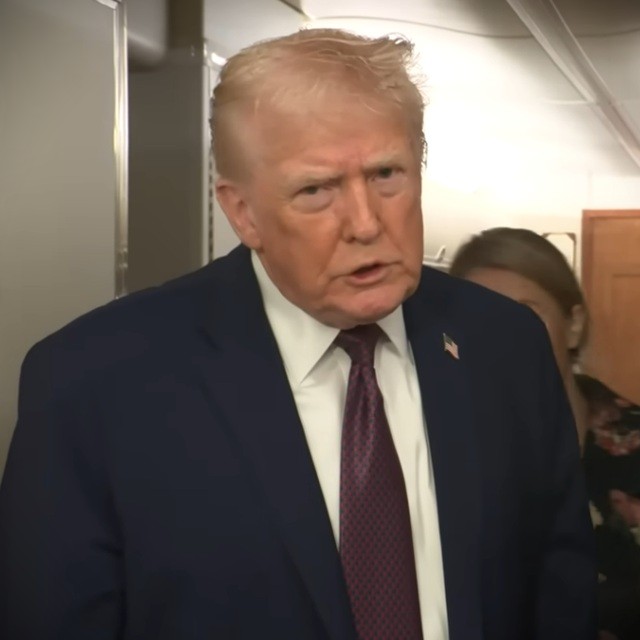
 President Donald Trump addressed a question about an Affordable Care Act subsidy bill Sunday while aboard Air Force One. Credit: White House
President Donald Trump might still be open to the possibility of signing a bill that would keep a high level of premium subsidies in place for people who get individual or family coverage from the Affordable Care Act public exchange system.
Seventeen House Republicans joined with House Democrats last week to pass a bill that could keep a temporary ACA premium subsidy boost in place for three more years.
The loss of the subsidy boost caused the average exchange plan user's out-of-pocket cost for premiums to double, and it pushed out-of-pocket costs for some older, higher-income families to more than $40,000 per year, from about $7,000 per year in 2025.
Trump touched on the "subsidy cliff" topic Sunday, during a press briefing aboard Air Force One, according to video of the event posted by the White House.
One reporter asked, "Mr. President, the House has a three-year extension of the ACA. It's in the Senate. If it passes the Senate, would you veto it or allow it to...?"
The president said, without any certainty in his voice, "I might. Yeah, I might."
Meanwhile, in a post on Truth Social, the president shared the views of Michael Cannon, an opponent of efforts to extend the ACA subsidy boost.
Cannon, director of health care policy at the Cato Institute — a think tank that traditionally has been popular with Republicans — supports getting around Affordable Care Act rules by letting insurers offer short-term health insurance policies that last for up to three years. Short-term health insurance policies fall outside the jurisdiction of the ACA requirements that apply to major medical insurance coverage, such as the ban on use of information about people's health in underwriting and the ban on exclusions for coverage for preexisting conditions.
"Subsidies will not solve this problem," the president wrote, quoting Cannon. "Government should be capping what it spends on Healthcare at ZERO. Send them a check. No need for subsidies. Congress has to get out of the way of Private Insurance Companies. Give the money to the Consumers to buy directly from the Health Insurance Companies."
The president did not elaborate on his version of Cannon's views and did not address issues such as what he thinks about short-term health insurance issuers' ability in many states to deny coverage to people with health problems and to exclude coverage for services such as preventive care and routine maternity care.
What it means: What members of Congress and the president decide to do about the ACA subsidy cliff could have a big, direct effect on whether clients under age 65 can get individual or family health coverage and how much they pay for the coverage.
Efforts to wrestle with the topic could also have a big, hard-to-predict effect on efforts to pass all kinds of other legislation, including bills that might affect annuities, life insurance, estate planning and health savings accounts.
Lawmakers could use ACA subsidy dealmaking conversations and dealmaking related to efforts to pass major appropriations bills — the legislative packages that will provide the funding needed to keep most of the government operating normally after Jan. 30 — to try to push their favorite legislation through Congress.
The backdrop: Sen. Bernie Moreno, R-Ohio, has been trying to put together a compromise bill in the Senate.
One of the House backers of the three-year subsidy extension bill, Rep. Mike Lawler, R-N.Y., said on the House floor that he voted for sending the three-year extension bill to the Senate to support the Senate negotiators' efforts to create a bill that can become law.
Trump has frequently argued that the Affordable Care Act has done more harm than good, but he has not recently taken direct steps to shut down the ACA public exchange system, bring back medical underwriting or eliminate premium subsidies altogether.
The president has said that he wants to see the subsidies go straight to consumers, rather than to health insurers.
Actuaries — insurance math experts — have noted that offering health coverage without medical underwriting is difficult and complicated, and that the main reason for the ACA subsidies and many of the ACA-related rules is the struggle to keep a "guaranteed issue" health insurance system from sending sicker people toward certain health coverage providers, or certain types of health coverage providers, and causing those providers to fail.
© Arc, All Rights Reserved. Request academic re-use from www.copyright.com. All other uses, submit a request to TMSalesOperations@arc-network.com. For more information visit Asset & Logo Licensing.