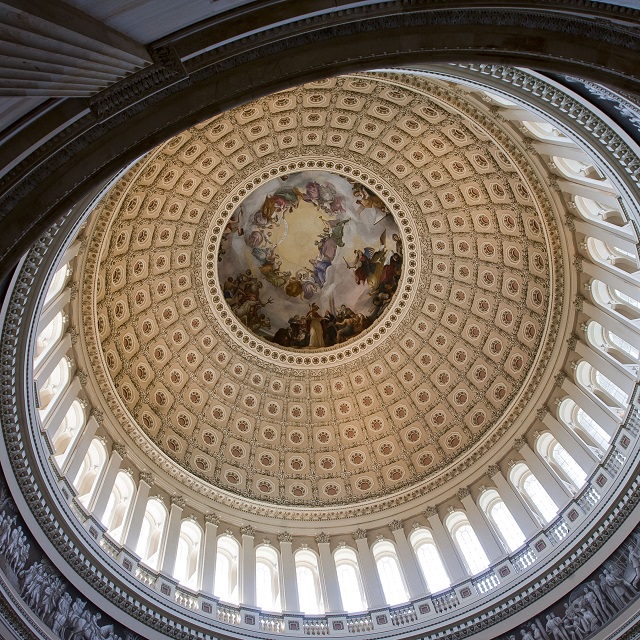
 The rotunda of the U.S. Capitol in Washington. Photo: Diego M. Radzinschi/ALM
A new House retirement plan bill could create a new market for individual annuities and annuity-like arrangements.
Rep. Richard Neal, D-Mass. — the highest-ranking Democrat on the House Ways and Means Committee — reintroduced the Automatic IRA Act Monday.
The bill would require an employer with more than 10 employees that has no other retirement plan to put the employees in individual retirement accounts, 401(k) plans or other arrangements that withdraw contributions from the employees' paychecks automatically.
One provision states that, for purposes of the auto-IRA bill, the term "IRA" includes individual retirement annuities.
What it means: Employer auto-IRA programs that incorporate annuities or other lifetime income features could create opportunities for insurers to expand lifetime income product sales and add competition for ordinary retail advisors.
Poorly designed auto-IRA lifetime income provisions could also complicate some individual clients' planning situations, by causing many more to come to advisors with small, hard-to-locate or poorly chosen lifetime income arrangements on their asset lists.
Contributions: The bill would require the initial default contribution to range from 6% to 10% of an employee's pay and then to rise by 1 percentage point every year.
After five years, the default contribution percentage would range from 10% to 15%.
Employers with 100 or more employees in a 401(k)-type plan would have to provide access to a lifetime income option. The employer would have to let any participant with a vested balance over $200,000 receive at least 50% of the balance through an arrangement providing lifetime income.
Employees could take active steps to change the contribution levels or opt out of making contributions.
Life and annuity implications: Life insurers and annuity advisors would get at least four chances to reach the workers.
They could sell:
◆ Individual retirement annuities for use as the vehicle for providing auto IRA benefits.
◆ Group annuities to any new 401(k) plans created.
◆ Individual annuities for use as lifetime income options.
◆ Annuitization features that aren't technically individual annuity contracts for use as lifetime income options.
TIAA — which is a big annuity issuer as well as a giant asset manager — has provided visible support for the Neal bill.
Legislative mechanics: Neal and other lawmakers have been introducing versions of the Automatic IRA Act bill since 2006. The bill has never gotten to the House floor. The new bill has no co-sponsors.
But Neal helped create the Setting Every Community Up for Retirement Enhancement Act of 2019 and the Secure 2.0 Act of 2022.
One wild card is the fight in Congress over what, if anything, to do about the looming Dec. 31 expiration of the current high level of Affordable Care Act premium subsidy payments.
The end of a temporary subsidy boost created in response to the COVID-19 pandemic is creating a "subsidy cliff." Some older, high-income exchange plan users could see their coverage costs rise to more than $30,000 per year in 2026, from less than $10,000 this year.
The subsidy cliff has led to a flurry of legislative activity and could create new opportunities for dealmaking.
Industry group reactions: Life and annuity organizations have expressed strong support for the Neal bill.
The American Council of Life Insurers predicted that enacting the bill could lead to about 35 million workers getting access to retirement accounts and 25 million workers using the accounts.
The participating workers might contribute about $160 billion per year to the accounts, according to ACLI calculations.
"Expanding access to workplace retirement plans is one of the most effective ways to help Americans save for retirement,” ACLI President David Chavern said.
The Insured Retirement Institute said the bill could be especially helpful to workers of color.
"By expanding access and strengthening savings tools, Congressman Neal's legislation will help workers and retirees achieve a secure and dignified retirement,” IRI President Wayne Chopus said. "Retirement security is foundational to economic dignity."
About half of Asian American workers, half of Black workers and two-thirds of Latino workers lack access to workplace retirement plans, the IRI said.
Finseca cited estimates that U.S. workers have a $7 trillion retirement savings gap and suggested that Neal's bill could help close that gap.
The bill "represents a meaningful step forward, particularly for young and low-income workers without access to workplace savings, to establish a stronger financial foundation," Finseca CEO Marc Cadin said.
The U.S. Capitol rotunda. Photo: Diego M. Radzinschi/ALM
© Arc, All Rights Reserved. Request academic re-use from www.copyright.com. All other uses, submit a request to TMSalesOperations@arc-network.com. For more information visit Asset & Logo Licensing.