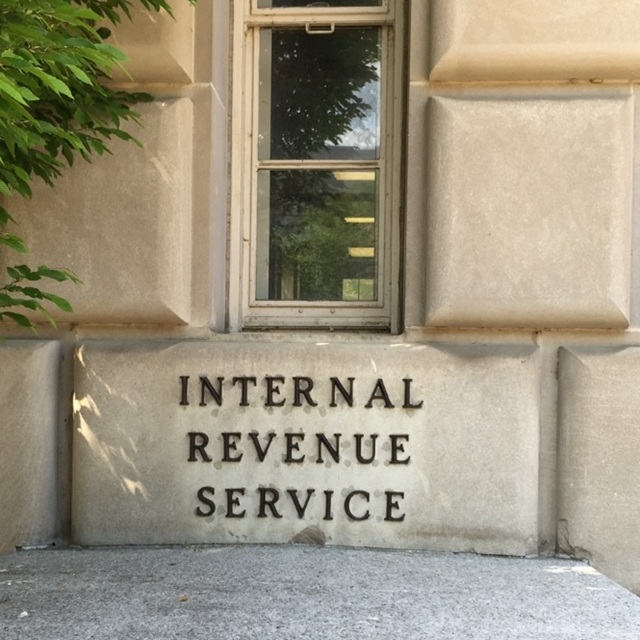
 The IRS headquarters in Washington. Credit: Allison Bell/BenefitsPRO
The Internal Revenue Service mentioned annuities, briefly, in a notice about its plans for regulating the new Trump baby accounts.
IRS officials said in a footnote in the notice that families cannot use individual retirement annuities to fund the Trump accounts.
But nonbank financial institutions that are approved by the IRS to be trustees for traditional IRAs can also be trustees for Trump accounts. Some life and annuity issuers are already approved to be trustees for traditional IRAs.
What it means: Insurers can act as Trump account trustees but, under the current rules, may not be able to sell annuities to the families with the accounts.
Trump account basics: Economists and others have argued for years that the federal government could help Americans immensely by contributing a small amount of cash to each child at birth and then letting compound annual investment returns make the cash grow.
The legal framework for the new Trump accounts is in section 70204 of the One Big Beautiful Bill Act.
Section 70204 of the act added section 530A to the Internal Revenue Code.
A Trump account, or "530A account," will be a special kind of traditional individual retirement account that a family can use to save for a child's future.
The federal government plans to put $1,000 in a Trump account for each baby.
Parents, guardians, employers and others can contribute $5,000 per year. The beneficiary can take tax-free withdrawals to pay for expenses related to education, the purchase of a first home or starting a business.
Eligible investments: Under the terms of the Trump account law, an eligible investment must be a mutual fund, an exchange-traded fund or an ETF equivalent with returns based on the S&P 500 stock index or a similar index, without the managers making any effort to outperform the index or reduce risk.
The annual fees and expenses for the fund can be no more than 0.1% of the account assets.
IRS officials' statement in the new notice that individual retirement annuities are not eligible investments may not shut out all annuities: Under IRS rules, an individual retirement annuity is different from an annuity held within traditional IRAs.
An annuity issuer could design an indexed annuity that might resemble an ETF.
For annuity issuers, one obstacle to selling annuities to Trump account holders is the 530A provision limiting fund expenses to 0.1% of the assets.
But the 0.1% limit might not include all expenses.
The total "would not include any amount that is paid to a broker or intermediary and that is not specified or imposed by or on behalf of the fund, such as a broker's sales commission," IRS officials wrote in the notice.
Another obstacle for annuity issuers could be IRS officials' view that an eligible investment must be registered as an open-end mutual fund, as an ETF, or as an "entity that operates in substantially the same manner as such a fund," such as a "unit investment trust operating under an exemptive order granted by the Securities and Exchange Commission."
IRS officials are asking for comments about their mutual fund and ETF definitions.
Comments are due Feb. 20, 2026.
Trump account trustees: Banks can serve as Trump account trustees.
Nonbanks that are approved to serve as traditional IRA trustees can also be Trump account trustees.
The current list of approved nonbank IRA trustees includes HealthEquity, Illinois Mutual Life, WEX and affiliates of Corebridge, John Hancock, Oxford Life, Primerica and Principal Financial.
© Arc, All Rights Reserved. Request academic re-use from www.copyright.com. All other uses, submit a request to TMSalesOperations@arc-network.com. For more information visit Asset & Logo Licensing.