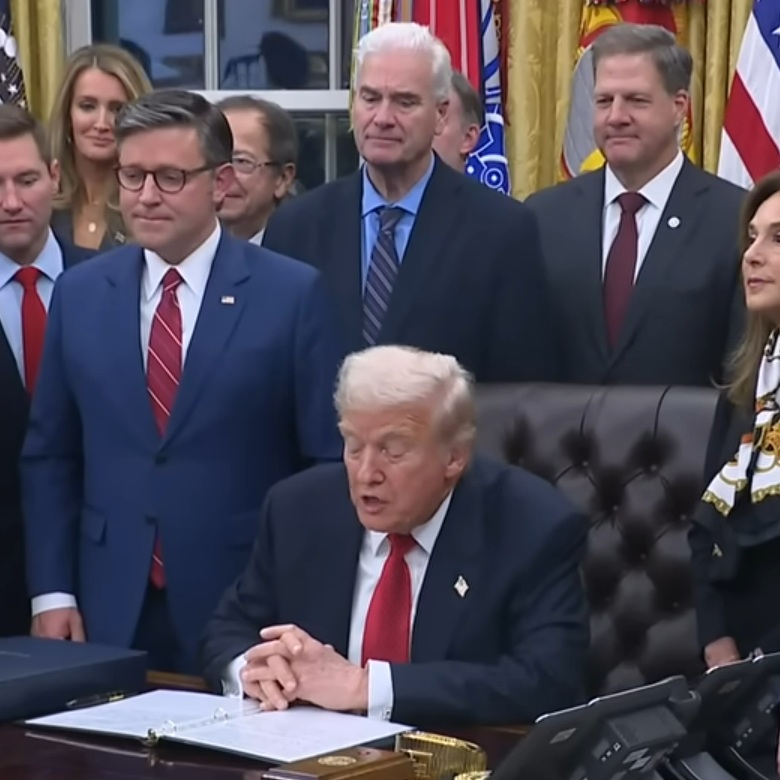
 President Donald Trump in the Oval Office Wednesday, at the signing event for the Continuing Appropriations, Agriculture, Legislative Branch, Military Construction and Veterans Affairs, and Extensions Act, 2026. Credit: White House
President Donald Trump could be about to try to change how the federal government helps people pay for individual commercial health insurance.
The president talked about a subsidy strategy shift in the Oval Office Wednesday evening, during a signing ceremony for H.R. 5371, the bill that provides the funding needed to end the partial federal government shutdown that began Oct. 1.
The Affordable Care Act now provides tax credits that people can use to help pay for individual health coverage. The cash goes to health insurers and reduces what consumers pay out of pocket each month for health coverage.
"I'm calling today for insurance companies not to be paid, but for the money to be paid directly to the people of our country, so that they can buy their own health care, which will be far better and far less expensive than the disaster known as Obamacare," Trump said at the bill signing.
"I want the money to go directly to you, the people, and you'll go out, and you'll buy your own health insurance, and you'll negotiate different plans, and you'll get much better insurance," Trump said. "We're going to forget this Obamacare madness."
What it means: The federal government could create a new mechanism for sending cash to consumers.
ACA premium subsidies: Originally, the ACA made the health insurance premium tax credit subsidies available only to people with income under 400% of the federal poverty level.
Congress responded to the COVID-19 pandemic by increasing the subsidy levels and by making the subsidies available to people at any income level if the cost of standard health insurance exceeded 10% of their income. The temporary subsidy boost is set to expire Dec. 31.
Democrats said they were refusing to vote for the funding needed to prevent the shutdown because they wanted Republicans first to agree to extend the current, relatively high level of federal individual health insurance premium subsidies that Congress provided in response to the COVID-19 pandemic.
The bill Trump signed Wednesday says nothing about health insurance premium subsidies.
Some Republicans have supported the idea of extending the current high level of premium subsidies, at least temporarily.
Some have backed letting the current subsidy levels expire and, possibly, sending cash to consumers.
Trump talked about sending cash directly to consumers in a Truth Social post on Saturday and in an interview that aired on Fox News Monday.
The future: Democrats could have leverage to shape any health subsidy change proposals, because much of the anti-shutdown funding provided by the act Trump signed is set to expire Jan. 30, 2026.
President Donald Trump in the Oval Office Wednesday, at the signing event for the Continuing Appropriations, Agriculture, Legislative Branch, Military Construction and Veterans Affairs, and Extensions Act, 2026. Credit: White House
© Arc, All Rights Reserved. Request academic re-use from www.copyright.com. All other uses, submit a request to TMSalesOperations@arc-network.com. For more information visit Asset & Logo Licensing.